The Regionals
The Sioux: Life and Customs of a Warrior Society, by Royal B. Hassrick
The Sioux: Life and Customs of a Warrior Society, by Royal B. Hassrick
Couldn't load pickup availability
MID-AMERICA + THE PLAINS.
Nonfiction / History, First Nations, 1975.
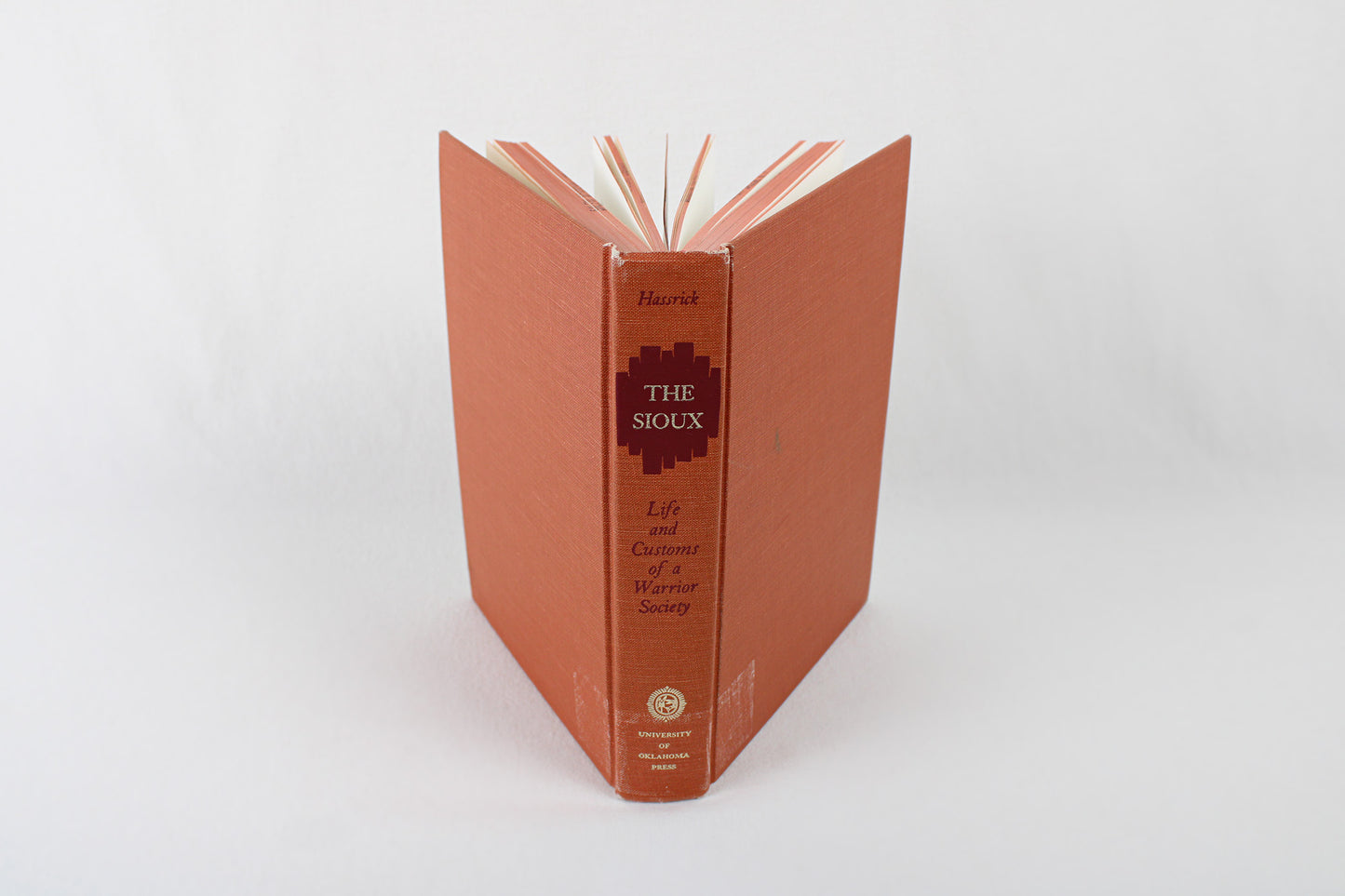
The Civilization of the American Indian Series is a long running well-regarded program of scholarly studies put out by The University of Oklahoma. The earliest volumes date to the 1930s. Royal Hassrick’s exhaustive work was for its time refreshingly pluralistic in its sourcing, including not only the standard well of white pioneer, frontiersmen, and migrant accounts of this legendary Indian nation, but also pulling in extensive details through interviews with tribal elders who had either lived through the final days of tribal freedom across the lake region, woodlands, and plains of the upper west, or heard their elders tell this history. The nation itself was then, and is still today, a sprawling set of tribes interconnected by language, tradition, and location. Today, the main linguistic / regional divisions of the Sioux consist of, from west to east (and stretching from the Dakotas to Wisconsin): the Lakota (Teton), Nakota (Yankton), and Dakota (Santee). (The term “Sioux” itself is no longer of use, it having been a corrupted French word from the start that is more or less viewed as an insult.) Given the popular idea of the Sioux as the pinnacle of Plains tribes, Hassrick decided to hone in on just the Lakota (to which he applies “Sioux” interchangeably), who were historically the largest of all the regional groups. From Hassrick’s introduction: “For many people the Sioux, as warriors and as buffalo hunters, have become the symbol of all that is Indian—colorful figures endowed with great fortitude and powerful vision. They were heroes of the Great Plains … and they were the villains, too … To attempt to describe the ways of a people, the patterns of their behavior, or the concepts of their imagination, is only less presumptuous than to try to interpret how their nation functioned. However, to understand the Sioux, it seems fitting to begin with their view of the world.” That Hassrick delved into the actual thinking, self-expression, imagination, day-to-day living, and the Lakota’s own interpretation of the world they had inhabited having roughly, violently, and tragically intersected with the country as it was to become is commendable. From the University of Oklahoma Press page, this final description: “There are chapters on the family and the sexes, fun, the scheme of war, production, the structure of the nation, the way to status, and other aspects of Sioux life.” [Condition: Used Very Good. This book came to us by way of an estate gift, but lived its previous life as a library book in North Carolina. That said, the checkout list attached to the inner back board shows that it was never checked out. That would track, as the volume’s interior is pristine. It does not seem it was ever read, if hardly ever opened. We would love to see it finally fulfill its role. There is only the slightest edge wear on the cover’s spine to report, along with remnants of library identification stickers.]
Condition: Used Very Good.
Nonfiction / History.
Royal B. Hassrick.
University of Oklahoma Press, 1975 (original © 1964).
Hardcover, 379 pgs, 5.5 x 8.25” / 1.5 lb
1 in stock